
Merchants at Sam's Club make thousands of assortment decisions every season. They balance supplier information, club allocations, financial goals, promotions, and physical space while working across multiple products and spreadsheets.
I joined the team to digitize the SKU Matrix—an Excel workbook merchants used to validate their assortments before execution.
Rather than jumping into interface design, I wanted to understand how merchants actually made planning decisions and whether the existing product ecosystem supported those decisions.
What began as a spreadsheet redesign quickly became a much broader product discovery effort.
I joined the team to redesign the SKU Matrix as part of a broader initiative to modernize the Buy Planning experience.
The existing product vision divided assortment planning into a series of connected tools, positioning the SKU Matrix as the final validation step before execution.

At first glance, the workflow appeared straightforward.
Before designing the experience, I wanted to validate one assumption: Did the existing product boundaries reflect the way merchants actually planned assortments?
Rather than beginning with interface design, I started by validating the assumptions behind the workflow. Merchant interviews quickly revealed that planning decisions were far more interconnected than the product boundaries suggested.
I expected to find one standardized SKU Matrix. Instead, every merchant showed me a different version. Some planned annual assortments months in advance. Others organized around seasonal resets. Others continuously optimized throughout the year. The spreadsheets weren't inconsistent—they reflected fundamentally different planning models.


I realized I wasn't replacing a spreadsheet—I was designing for multiple planning models. Instead of asking: How do we digitize the SKU Matrix?
I started asking:
Although every merchant used a different spreadsheet, the underlying decisions were remarkably consistent. Understanding those shared decision patterns became the foundation for the experience.
Once I realized every merchant organized the SKU Matrix differently, I stopped documenting spreadsheets and started documenting decisions instead.
For every stage of assortment planning, I documented:
What merchants were trying to accomplish
What questions they needed answered
What information they relied on
Which product owned that information
What happened when that information wasn't available
Rather than mapping products, I mapped decision ownership.

This framework became my lens for evaluating the existing ecosystem. Instead of asking whether a screen was usable, I could now ask: Was the right information available? Was the decision supported? Who actually owned this part of the workflow?
Mapping the assortment planning workflow revealed a gap beyond the SKU Matrix itself: some of the most important planning decisions were not fully supported by any product.
One example was Line Review — a critical checkpoint where merchants evaluated whether an assortment could meet its financial and operational goals before moving forward.
The information needed to make that decision already existed, but it was fragmented across several tools outside the Buy Plan experience. Merchants had to manually pull together sales, productivity, space, club distribution, and item-status information to build a complete picture.
The question they were ultimately trying to answer was simple:

The data existed — but no single product brought it together around the decision merchants needed to make.
Rather than optimizing individual products, the opportunity became reducing friction between planning decisions. Designing around merchant workflows—not product boundaries—would create a more cohesive planning experience.
The research revealed that merchants did not experience assortment planning as a series of separate product workflows. They moved continuously between distribution, financial validation, space planning, and assortment decisions as the plan changed.
A distribution change could trigger another round of validation:
Adjust distribution
Check financial impact
Validate available space
Reassess the assortment
Repeat
The existing ecosystem separated these activities across products.
Research showed that merchants moved between line review, item planning, club distribution, and SKU-level validation as they refined the same assortment plan. Rather than designing each activity as a separate product experience, I explored a shared planning model that let merchants move between different decision views without losing context. These concepts were not production designs. They became conversation tools for evaluating how the broader Buy Plan experience could evolve.
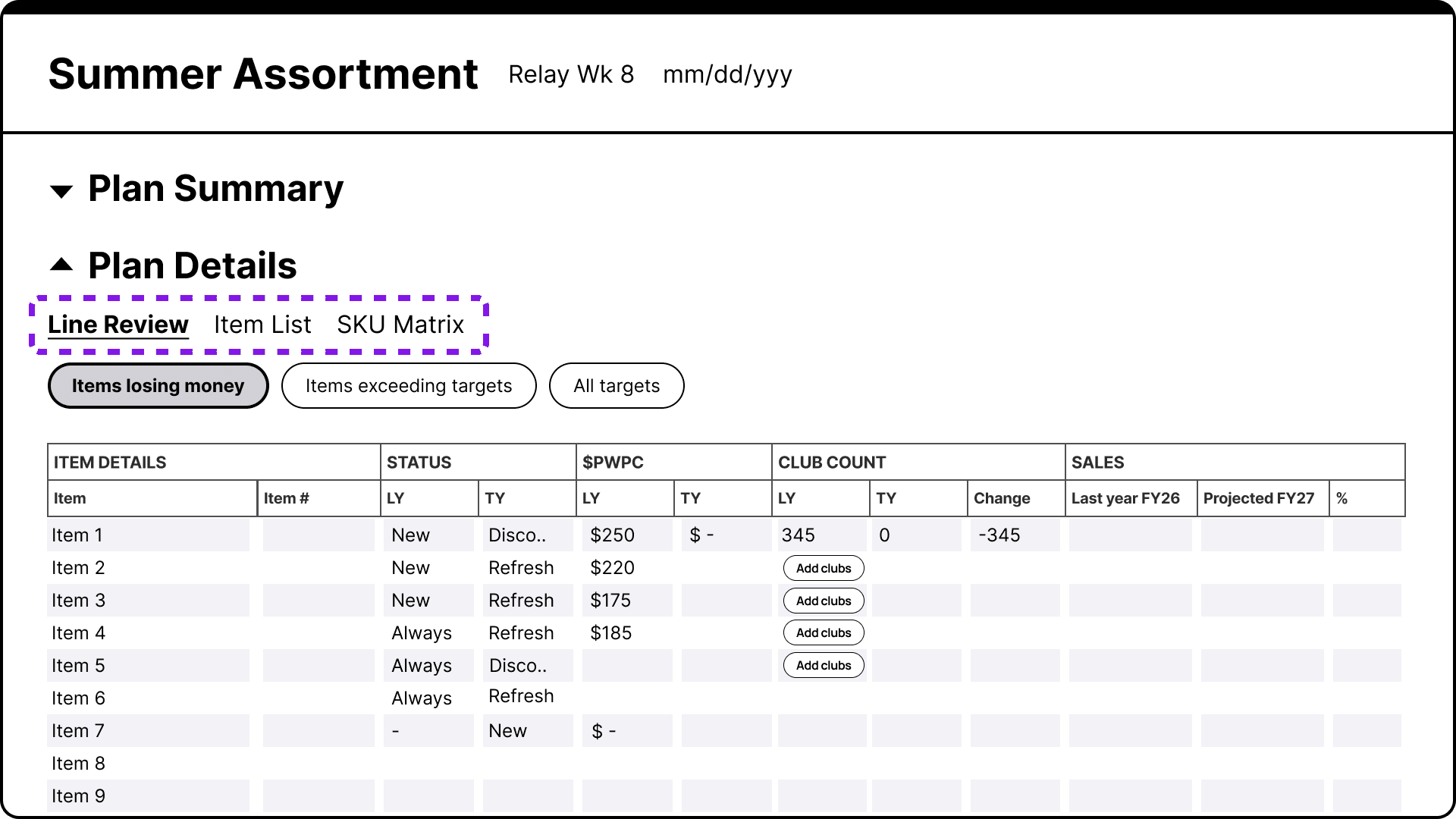
Line review: Evaluate the overall assortment and prepare for planning conversations.

Item List: Understand which items are entering, exiting, or changing within the assortment

SKU Matrix: Validate how those items are distributed across clubs and whether the plan fits within space constraints.
In the previous hierarchy the ai recommendation tool was much deeper in the hierarchy, but i redesigned the hiThe existing experience treated Club List recommendations as a separate, deeply nested destination.
I explored moving that capability closer to the moments when merchants were deciding how many clubs should carry an item and which clubs those should be.
Rather than turning the SKU Matrix into a recommendation tool, the concept made recommendations available in context while preserving the merchant's ability to review and adjust the final distribution.erarchy to make it higher in the hierarchy. I added a button whenever they were making a decision to add a club count across all 3 pages.

The revised hierarchy separated two different jobs:
Item setup happens once when an item enters the system.
Assortment planning happens repeatedly as merchants evaluate items, line reviews, club distribution, and SKU-level constraints.
Moving item setup outside of the plan reduced unnecessary hierarchy, while placing Club List closer to the SKU Matrix connected it directly to the distribution decisions it supported.

The Line Review, Item List, and SKU Matrix were designed as different views of the same underlying plan rather than independent workspaces.
A change made while adjusting club distribution could therefore remain visible when the merchant returned to another planning view.
This allowed merchants to move between higher-level assortment decisions and detailed distribution work without recreating or reconciling information across separate tools.

The original goal was to digitize the SKU Matrix.
Discovery revealed that the SKU Matrix couldn't be designed in isolation because it depended on planning activities, information, and workflow transitions that weren't yet represented in the existing product vision.
Rather than continuing implementation, the team paused the initiative to better define the end-to-end Buy Planning experience before investing further in design and engineering.
The research helped the team:
Build a shared understanding of how merchants actually planned assortments.
Identify critical planning decisions that lacked product support.
Clarify how recommendation, financial planning, and space validation worked together.
Reduce product risk before additional investment in design and engineering.
I joined this project expecting to redesign a spreadsheet. Instead, I discovered that the spreadsheet was simply the visible part of a much larger planning system. The most valuable artifact I created wasn't a wireframe—it was a framework that connected merchant goals, decisions, information needs, product ownership, and business risk.
One piece of feedback from my Product Manager has stayed with me: "You brought clarity to the team because you asked really good questions."
Looking back, I think that captures the real outcome of this project. Discovery wasn't about validating a solution. It was about creating enough shared understanding for the team to confidently rethink the problem before building it.
Tara Isabel
Projects
Workflow Management System
SKU Matrix