
Within Sam's Club Merchandising, launching a product requires coordination across multiple cross-functional teams—from item setup and purchasing to space planning and in-club execution. Each team relied on spreadsheets, emails, and disconnected partner tools to communicate progress, resulting in limited visibility, delayed updates, and operational bottlenecks.
The Workflow Management System (WMS) was created to bring these teams together by surfacing workflow progress across partner applications in a single operational platform. Built on Camunda, the platform provided a shared foundation for orchestrating workflows while allowing teams to continue working within their existing tools.

When I joined the project, the workflow model had been designed for a single sequential use case. As the product expanded to support additional partner teams, it became clear that the existing architecture would not scale.
Operational workflows required more flexibility, including:

Conditional logic
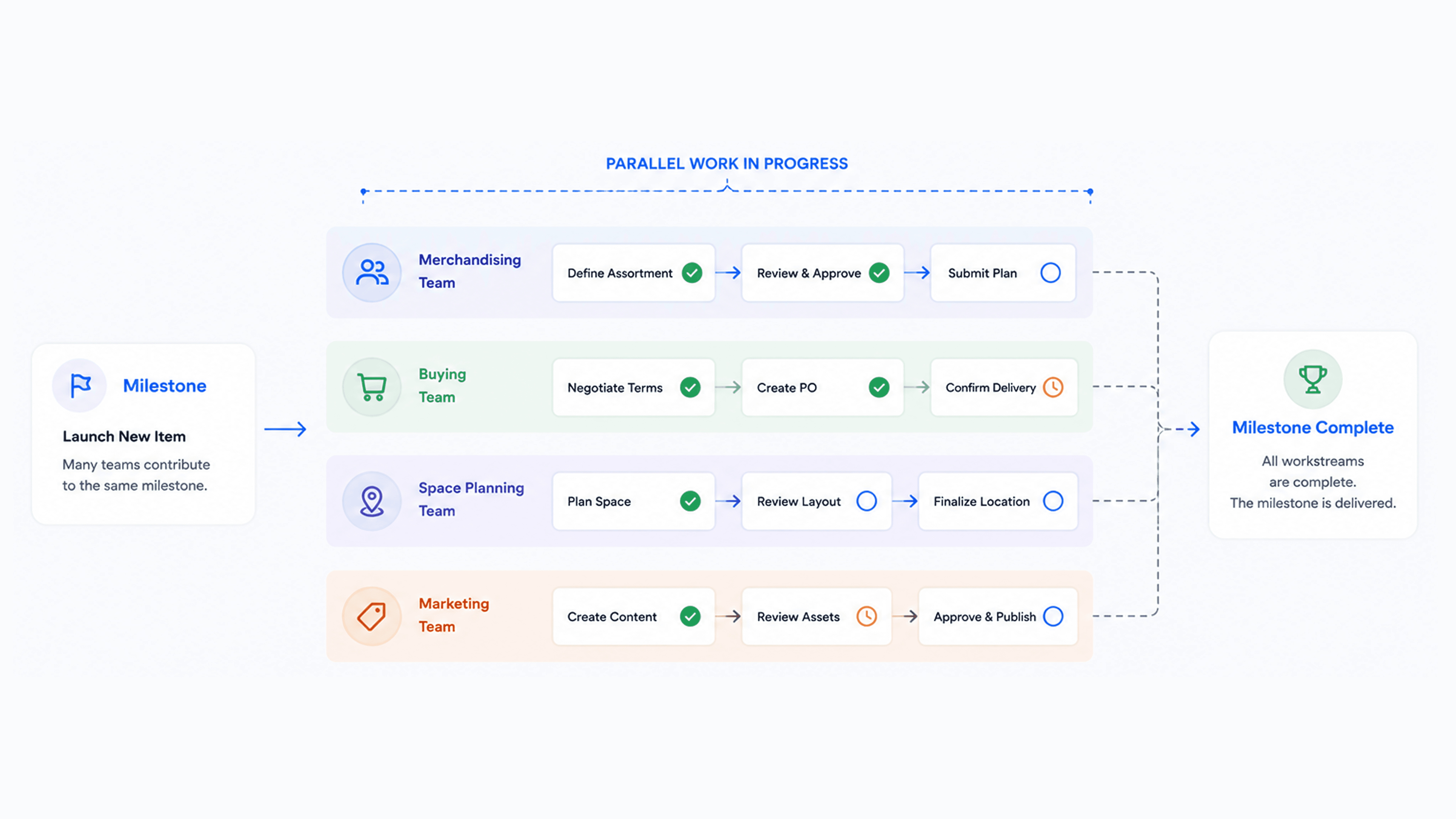
Parallel workstreams
I also discovered a second challenge: partner teams struggled to onboard because workflow terminology and documentation lacked a consistent structure. Users frequently confused workflows, milestones, tasks, and tracked entities, making workflows difficult to author and understand.

When partner applications onboard with workflow management system, they need to fill in a workbook of their processes. Here's an example of how they filled it in. Most of the time tasks did not sound like tasks and milestones did not sound like milestones.
Working closely with product and engineering, I redesigned the workflow model to support sequential, parallel, and conditional workflow patterns while remaining within the technical constraints of Camunda.
Through prototypes and collaborative workshops, I demonstrated why the existing model would not scale, helping the team redesign the architecture before launch and avoid future technical debt.

To help new teams adopt the platform, I replaced static documentation with a guided onboarding framework that standardized workflow definitions, terminology, and authoring practices.
I later designed an AI-assisted onboarding experience that generated workflow tables and suggested standardized taxonomy, improving consistency and reducing onboarding effort.

Presentation decks

Confluence onboarding page

I created taxonomy guidelines that I later fed into my AI chatbot

AI-assisted onboarding agent that generates live workflow tables and standardized taxonomy in real time
I redesigned the platform's information hierarchy to help users better understand workflow structure and progress.
By introducing clearer taxonomy, stronger contextual labeling, and a more intentional hierarchy, users could more easily distinguish between workflows, milestones, tasks, and tracked entities while understanding how each level related to the overall process.

Shared detail page: Before

Shared detail page: After

Card design: Before

Card design: After
A centralized view of workflow health, ownership, deadlines, and blockers across teams.

A shared operational workspace for tracking milestones, tasks, dependencies, and workflow progress.

A personalized workspace focused on actionable work across multiple workflows. Only tasks that belong to that specific user are included on this dashboard.

Established a scalable workflow architecture supporting sequential, parallel, and conditional workflows.
dentified architectural limitations before launch, preventing future technical debt.
Improved workflow comprehension through clearer information architecture and standardized taxonomy.
Created reusable onboarding frameworks for cross-functional partner teams.
One of the biggest lessons from this project was realizing that the most impactful UX decisions were not purely visual. The largest improvements came from redesigning workflow architecture, onboarding processes, and operational consistency.
Partnering closely with engineers during discovery helped us identify workflow limitations before they became larger platform issues. It reinforced the importance of involving UX early when defining system behaviors and workflow logic.
This project reinforced how heavily enterprise usability depends on taxonomy, hierarchy, and contextual communication. Clear labeling and structured workflow definitions became just as important as interaction design itself.
Tara Isabel
Projects
Workflow Management System
SKU Matrix